ke stažení: mapa Zadar
Welcome to the city of Zadar, a city of exceptional history and rich cultural heritage, a city of tourism. Our web site will try to offer you a complete tourist offer, from searching for an ideal accommodation, autochthonous gourmand delicacies, cultural monuments, a variety of excursion programs and numerous tourist activities that the city offers by combining the beauty of the past and all the privileges that the modern traveller demands.
The particularity of the city is irresistible for those who respect and admire historical monuments and cultural heritage, artists, tourists and its citizens. Zadar is a city monument, surrounded by historical ramparts, a treasury of the archaeological and monumental riches of ancient and medieval times, Renaissance and many contemporary architectural achievements such as the first sea organs in the world.
Zadar is a city where huge spaces are left for pe¬destrians. Using your guidebook, your walk along the cobblestone streets of the city will become a walk through history, and also an experience of the contemporary life of the city. When tired, do try to take a break in one of our restaurants, pastry shops or coffee shops that you can find in the gastro offer of this guidebook. Enjoy listening to the concerts, visit the theatre, museums, and exhibitions.
Situated in the heart of the Adriatic, Zadar is the urban center of northern Dalmatia as administrative, economic, cultural and political center of the region with 92,000 inhabitants.
The coast is particularly indented, the islands and the untouched nature allures many boaters to this regions. The archipelago counts 24 bigger and about 300 smaller islets and rocks, 3 nature parks - Telašćica, Sjeverni Velebit and Vransko jezero and 5 national parks - Paklenica, Plitvice lakes, Kornati Islands, Krka and Velebit classifying Zadar and its surroundings at the very top of the Croatian tourist offer.
Centuries-old tumultuous history, destructions and reconstructions have left scars but also a rich historical legacy and today's valuable monumental heritage of the city. Numerous churches and cultural monuments dating from all historical periods have been preserved thus representing architectural works of art, from the Roman period trough Middle Ages up to the modern architecture. In the historical city centre there are around 70 of them, while other parts of the city with its close and extended surroundings number more than 600 cultural monuments. Here are just a few of those:
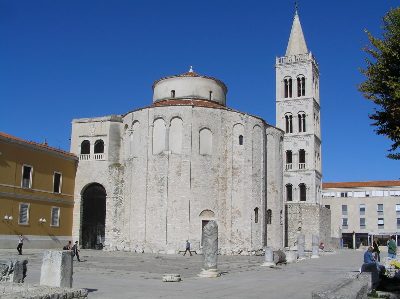
Church of Saint Donat - the symbol of the city of Zadar and the most famous monumental edifice in Croatia from the early Middle Ages (9th c.). Round pre-Romanesque church which was called the Church of the Holy Trinity until the 15th c., and from that time on carries the name of Saint Donat, by the bishop who had it built.
The gold and silver of Zadar - Within the structure to the church of St. Mary, or more specfically her monastery, whose property was Heavily damaged during the Second World War a Representative exhibition was formed in 1972 - the Permanent Exhibition of Religious Art, one of the most worth-while exhibitions in Croatia, popularly called "The Gold and Silver of Zadar".
The exhibition "Gold and Silver of Zadar", initiated in 1951 by the Croatian writer Miroslav Krleza, was transformed in 1976 into a permanent display of the Permanent Exhibition of Ecclesiastic Art in the Benedictine Convent of St. Mary in Zadar, one of the first capital buildings of Croatian culture. On the occasion of the exhibition, Krleza wrote one of his best essays, in which he glorified the treasures of Zadar. The gold and silver of Zadar shine on a surface area of about 1200 m2 in 8 modernly equipped halls, including the reconstructed interior of the old Croatian Church of St. Nediljica from the 11th century. Also included are manuscripts, sculptures, embroideries, tapestry, reliefs, etc., as evidence of the rich past of Zadar from the 8th to 18th centuries, as a town which was an important cultural center, particularly in the Middle Ages. Joys, hopes, patience, suffering, and faith of the tumultuous era of this region's history are woven into the relics and chalices, sculptures, paintings, and embroideries.
The church was mentioned for the first time in mid 10th c. in the documents of the Byzantine emperor Konstantin Porfirogenet. Today its space is used, due to its extraordinary acoustic features, for musical performances.
Saint Anastasia´s cathedral - the biggest cathedral in Dalmatia. Its oldest parts are an early Christian basilica, but its present Romanesque appearance was shaped in the 12th century. During the crusaders' siege and conquest of the city in 1202, the Cathedral was damaged, but later it was reconstructed and made longer.
The portals are lavishly adorned by relief and an inscription of Archbishop John from the year 1324. Its bell-tower was built in the 15th and 19th c. mostly in a neo-Romanesque style.
Museum of Ancient Glass Zadar - The Museum of Ancient Glass is situated in the renewed Cosmacendi house and an added structure, annex in the courtyard of the existing building which consists of a basement, ground floor, first floor and attic with the surface of 1601,4 m2 (gross). Annex consists of a basement, ground floor and first floor with the surface of 972,8 m² (gross). Part of the natural terrain is the belonging park. The lot has irregular form, it is situated close to the city walls near the main city entrance (Moro bastion from the 16th century).
Sea Organ is situated near the new cruiser port, as a part of Zadar's Riva, and can be observed as a differently shaped part of the coast which consists of several stairs that descend into the sea. The stairs extend for about 70 meters along the coast, under them, at the lowest sea-tide level, 35 pipes of different lenght, diameter and tilts were built in vertically to the coast and they raise aslant until the paved part of the shore and end in a canal (a service corridor). On the pipes there are LABIUMS (whistles), which play 7 chords of 5 tones. Above the canal there are perforated stone stairs through which the sound comes out, the air pushed by the sea.
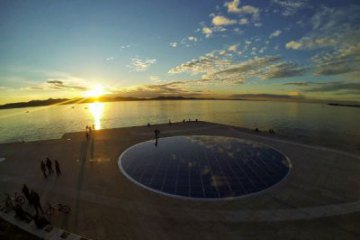
After the world-known Sea Organs, Zadar has become wealthier with one more urban installation. On Istarska obala, at the very end of the Zadar peninsula, next to the famous Sea Organs, shines the Greeting to the Sun made by the same architect Nikola Bašić.
The Greeting to the Sun consists of three hundred multi-layered glass plates placed on the same level with the stone-paved waterfront in the shape of a 22-meter diameter circle. Under the glass conduction plates there are photo-voltage solar modules through which symbolic communication with nature is made, with the aim to communicate with light, just like the Sea Organs do with sound.
National Park Krka Waterfalls + ŠibenikNational park Kornati National Park PaklenicaModrić CaveRiver Zrmanj - CanoeVrgada - island of the robinsonsZadar and it´s surroundingPanoramatic boat voyage on the Pašman channelFish picnic - VrgadaJeep SafariPanoramatic evening boat trip to ZadarOne-day sailingBungee JumpingSemiSUBMARINE BIOGRAD na MoruHorseback riding - VranaBurnum - archeologické naleziště v národním parku KrkaIsland VisovacSrima - Prižba - Double churchesArchaeological site CRKVINA
› Complete offer of accommodation Zadar
cztip.cz - ubytování ČR, SR, Wellness pobyty, CAMP.CZ - Kempy ČR, Web-tour.cz - on line zájezdy, BRENNA - Řecko, O Chorvatsku, Robinzonády
Copyright © chorvatsko-levne s.r.o., Summer 2012 Croatia Site by WERC