ke stažení: mapa Bol - Island Brač
Bol is the oldest coastal settlement on Brač. It exists in the solitude of the southern landscape, at the foot of the Bol crown and Vidova Mountain – the highest island peak and at the same time the highest point of all Adriatic islands (778 m). It stretches few kilometers along the coast. The sea in front of it is crystal clear, transparent waves resemble a cut crystal. Bol has many beautiful beaches. To the west from Bol lies the beach Zlatni rat (Golden Horn) one of the largest and most beautiful attractions of the Adriatic. Like a small tongue it extends nearly half a kilo-metre into the clear blue sea.
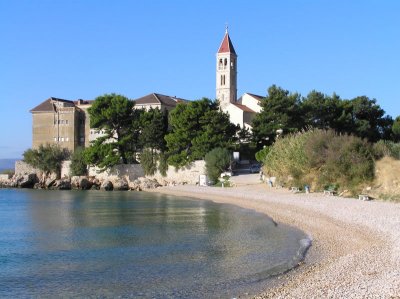
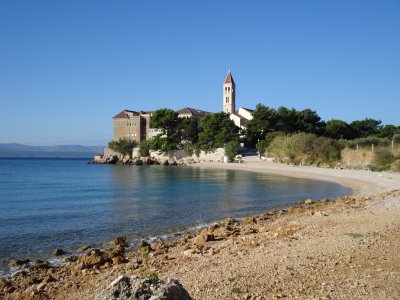
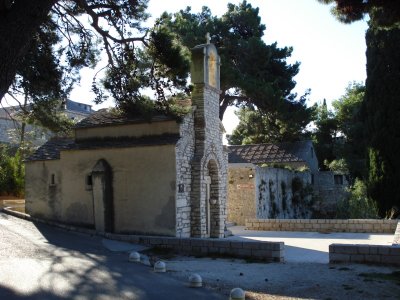
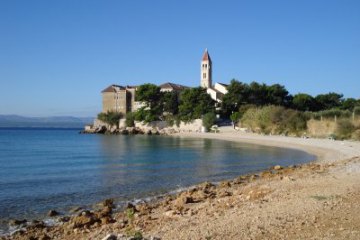
It “grows” with the depositing and sedimentation of small gravelly pebbles around the underwater reef. The point of the Zlatni rat (Golden horn) changes shape, attempting to conform to the will of the waves and gentle sea currents. Dominican monastery, rising in the holy peace is located on the east side of Bol, at the peninsula Glavica. Its museum has a rich archeological collection and diverse valuable objects and paintings.The urban core of Bol is shaped along the port. There are baroque summer residence, Loza with a little church, renaissancee-baroque palace with an art gallery inside it, parish church, little market and Kastil. Stylish buildings modestly fit the harmonious houses made in the original national architectural style… The west side of the settlement has been built more recently. The main hotels in Bol are located in the area towards Zlatni rat. Bol is a locality of exceptional maritime benefits. Its coast with numerous corners of peace and pleasures gives a feeling of a large free space, is created for meditation and relaxation but also for active holidays. The scent of medicinal sage and rosemary under the sunny slopes,and chirring of crickets is the deepest primeval music. In this area, each visitor will be able to enjoy himself/herself.Brac was inhabited already in the prehistoric times, probably in the Mesolithic, but certainly in the Neolithic, i.e. at the end of the III. Millennium B.C. by pre-Indo-European population, whose main occupation was cattle-breeding. In the II. Millennium, during the time of metal cultures, the island was inhabited by Indo-European Illyrians who were more cattle-breeders than farmers.The Romans were not founding settlements but were organizing farmhouses (villa Rustica).
At the end of the 8th or the beginning of the 9th century, Croatians from Neretva came to these areas. They pressed the Romanized autochthons Illyrian population. At that time, island of Brac was under the Franks. At the beginning of the 11th century, the Venetians took over these areas. Mid-century, Brac was a part of the Croatian state during the reign of Petar Kresimir IV. In the 12th century, these areas were officially a part of Byzantium, but were governed by the Venetians. During the reign of the king Koloman in 1107, Brac was a part of Croatian-Hungarian state. But in 1135, Venice conquered Brac, only to fall under Byzantium again for a short while in 1170, since already in 1180, it again became a part of Croatian-Hungarian state. Andrija II., Croatian-Hungarian king donated Brac to Krk Dukes Frankopans.
Afterwards, Brac was occupied by the Omis pirates. Brac residents asked Venice for protection and were indulged. So on 1 April 1278, these areas fell under Venice and were governed by it until 1358. The same year, Brac was once again a part of Croatian-Hungarian state. Brac continued to change its rulers often. In 1390, it was under protection of the Bosnian king Tvrtko I., in 1394 it was ruled by the Croatian-Hungarian king Sigmund, in 1403 the island was ruled by Hrvoje Vukcic, and in 1413 it fell into the hands of Dubrovnik. Finally, in 1420, Brac was conquered by the Venetians who ruled it under 1797, i.e. until the demise of Venice. Venice was officially respecting their communal structure and allowed all forms of communal self-administration, but in practice it was implemented in accordance with their own laws and bureaucracy, through which it was intensely interfering with internal affairs in the commune. It abolished the provisions of the Common Law and introduced joint legislation under the rule of providur. Brac dukes were mainly impoverished Venetian nobility who came to the island to get rich. They were reducing the communal self-administration and acted arrogantly.
With demise of Venice, the Brac residents believed they were liberated from all obligations and free. However, the same year, Austria occupied these areas and governed them until 1805. With Pozunski peace treaty in 1805, this area fell under French administration which introduced many economical reforms. Nobility was abolished and schools established.
In December 1806, the Russians took over Brac, but already mid 1807, the French returned again, but there was no peace. The English ships attacked the island twice in 1811 and 1812. In June 1811, one English corvette attacked Bol, destroyed several ships at the port and took to island of Vis rich pillage of wheat, oil and wine.
After the demise of Napoleon, on 7 July 1814 Brac again fell under Austrians. In 1823, there was a new territorial division of the island. Brac was divided into 7 municipalities, among which was Bol.
Long and hard battle for Croatian language and for getting united with Croatia followed. Finally in 1883, Bol populists managed to get installed as the managing municipal body. The second half of the 19th century was the time of national awakening. In 1897, Croatian reading room was founded. As of 1 December 1918, Bol was a part of the new country (Yugoslavia) in which their national drams did not realize.
After the tempestuous Second World War, Bol was a part of SFR Yugoslavia, until the establishment of independent and autonomous Republic of Croatia.
WINDSURFING
Today Bol has become a favorite destination for surfers from various parts of Europe and the world. The sea channel between the islands of Brac and Hvar and the wind that blows there provide ideal conditions for windsurfing.
For all surfers and those looking to become ones, four surfing centers are available in Bol.
Thanks to them, Bol has a reputation of a well-known windsurfing destination.
Many competitions are held each year. Windsurfing centers rent entire sailing equipment and offer to guard your equipment during your stay in Bol. Sailing schools are also organized for beginners and for those more advanced.
WATER SPORTS
In the aquatorium surrounding the unique beach "Zlatni rat", you can enjoy many sports and escapades at sea.
You can swim or take a ride in boats, self-bailing pedal boats, gondolas, kayaks...
Water-ski lovers will be enjoying themselves as well.
Adrenaline junkies will try crazy rides on bananas and rubber rings, while the bravest ones can enjoy the jet-skis. A ride with a parachute which is being dragged by a speed-boat will let you enjoy the air view.
But diving will make for the best memories. Guides will take you diving to many attractive underwater localities, and if you do not have your own equipment, you can rent it.
Scuba diving courses are organized as well.
So the only thing you have to do is come to Bol and enjoy being by the sea, over the sea and under the sea...
OTHER SPORTS
Besides tennis, windsurfing and other watersports, in Bol you can:
play football on small field,
try handball,
enjoy yourself with basketball,
jump on trampolines,
ride bikes(mountainbike),
switch tennis for tabletennis,
enjoy volleyball in sand...
BY PLANE
During summer months, Bol has excellent links with all larger European cities. Brac Airport is located only ten kilometers from Bol. Croatia Airlines, and other European air-carriers offer very favourable seasonal flights to both Bol and Split, since Split Airport is also close to Bol.
BY TRAIN, BUS AND BY CAR
Croatia and Bol have excellent highway and railway links with Europe. You can look up detailed information on arrival and road conditions on the web pages of the Tourist Board of Croatia and/or Croatian Autoclub. If you are already on Brac, you can look up everyday bus lines Supetar-Bol on the web pages of Autotrans Brac.
Split + TrogirBačinská jezeraDubrovníkMostar - waterfall KravicaMedjugorje - waterfall KravicaBiokovo picnicBrač - PovljaRafting on river CetinaEvening panorama of Makarska
› Complete offer of accommodation Bol - Island Brač
cztip.cz - ubytování ČR, SR, Wellness pobyty, CAMP.CZ - Kempy ČR, Web-tour.cz - on line zájezdy, BRENNA - Řecko, O Chorvatsku, Robinzonády
Copyright © chorvatsko-levne s.r.o., Summer 2012 Croatia Site by WERC